
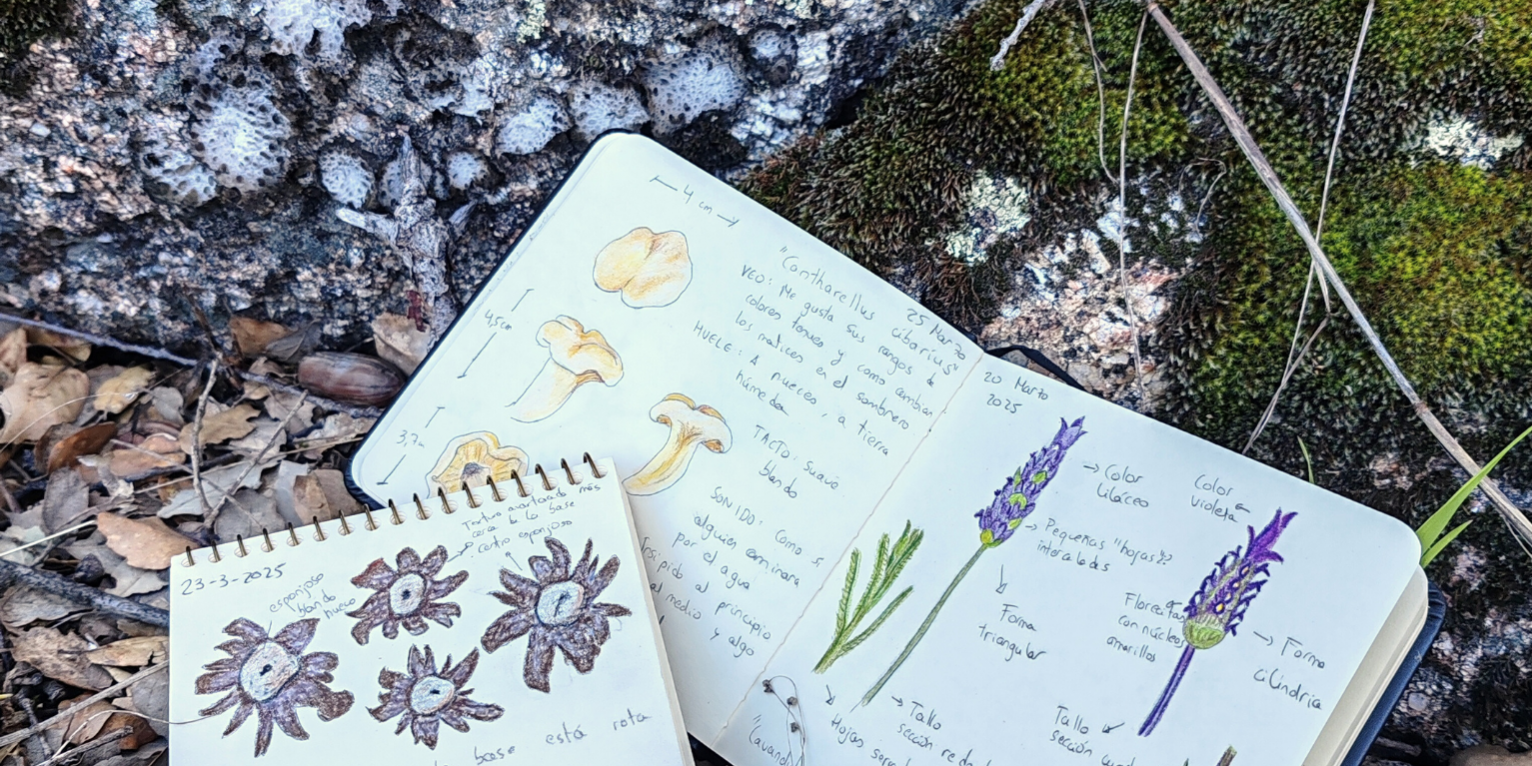
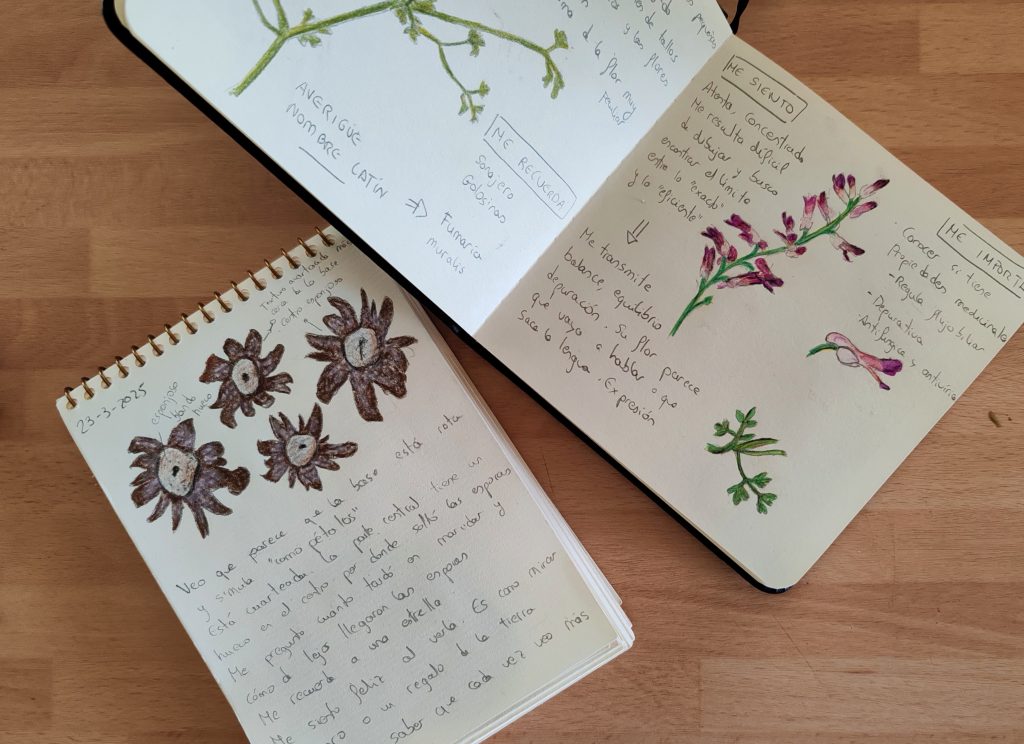
To take up again such a healthy practice as keeping a nature diary (Nature Journaling) will help you connect with your surroundings and give you the time and space to rest and benefit from «mindfulness». Since ancient times, great thinkers, scientists, inventors, educators and so on have carried a notebook with them to jot down their thoughts. Even early hominids recorded what they observed in their environment through petroglyphs and cave paintings. Today, neuroscience has uncovered the significant benefits of writing and drawing as a way of capturing observations, ideas and reflections on our environment.
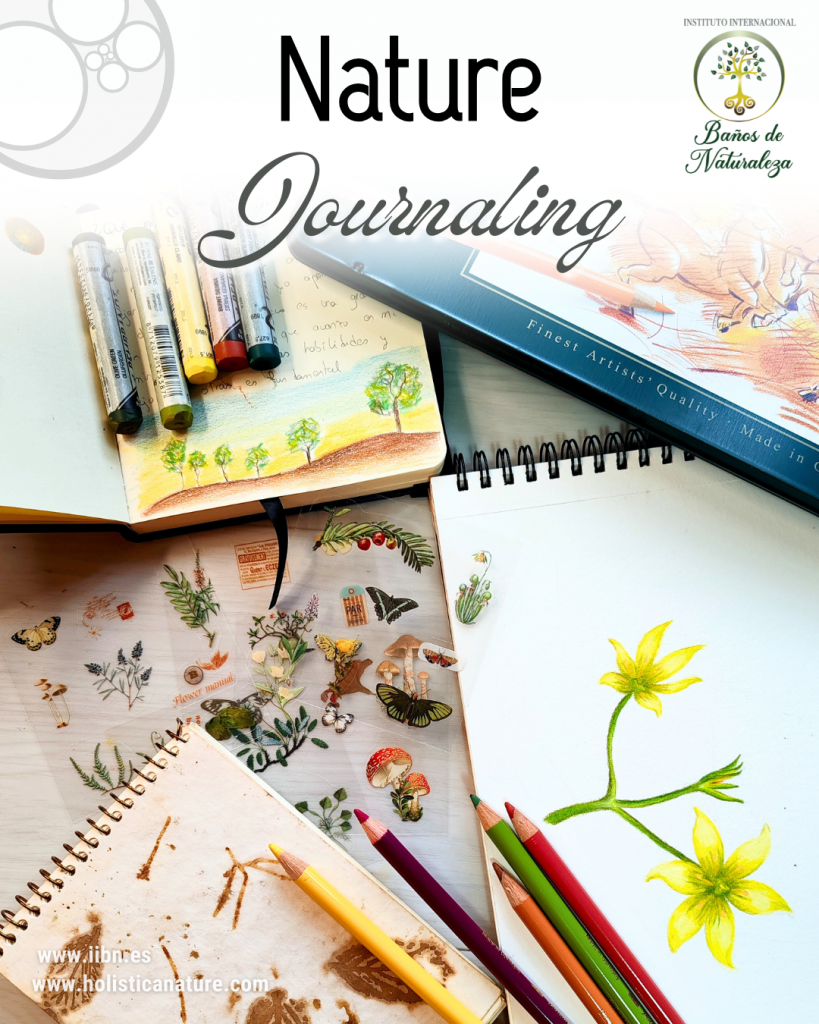
What is a nature diary?
A Nature Diary (Nature Journaling) is a way of cultivating curiosity, asking ourselves questions, and capturing our observations of our surroundings, as well as our sensations and feelings about them, thereby breaking down the false division between «internal» and «external» nature… It allows us to take an integrated view of ourselves within our environment as part of it, rather than an detached and distant perspective in which the natural world is merely a source of resources. According to Audubon Adventures author of «Nature Journaling for Everyone»The ultimate aim is to answer the question «What is happening out there today?», and from a personal development perspective, we would add: «How do I relate to what is happening out there? Who am I as I observe?»”
I firmly believe that observation leads to knowledge; knowledge leads to care; care leads to management; and management leads to conservation. Sandy McDermott
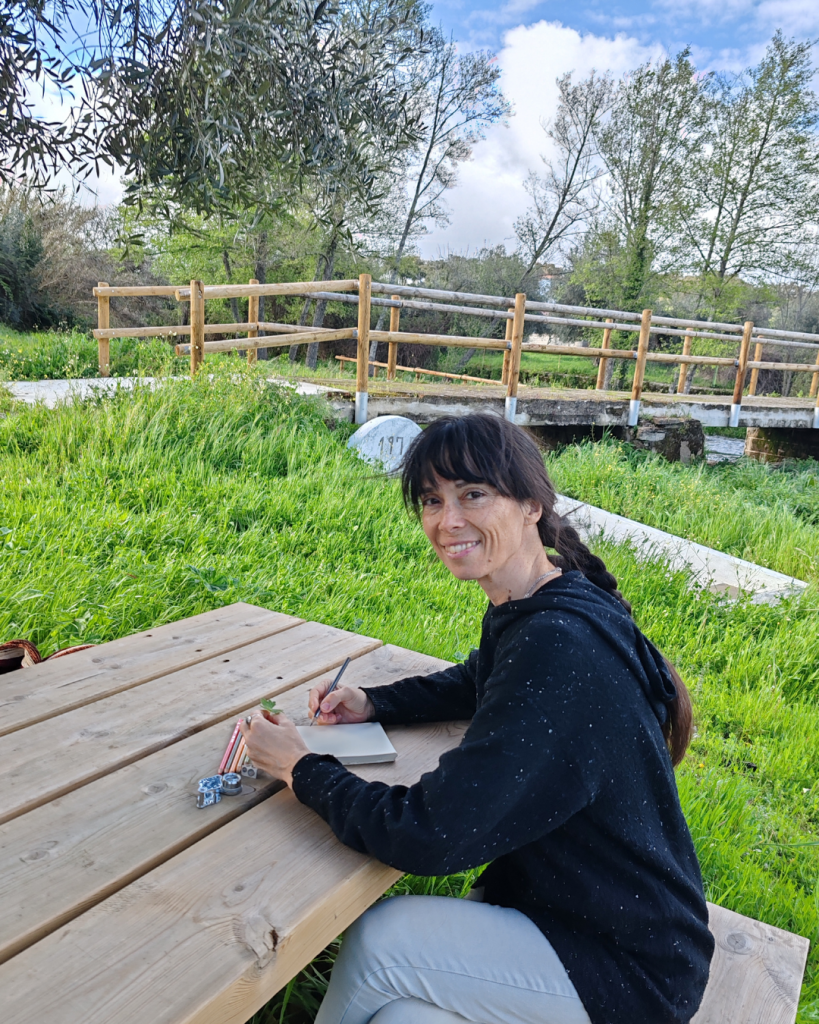
The wonderful thing about this activity is that it falls under the heading of «personal freedom»; in other words, everyone can do it in whatever way they like, as there are no set rules on how it should be or how it ought to be done. In this article, we’ll give you some guidelines on how to go about it, but remember that it’s a personal tool and, as such, it should allow you to capture your experiences in nature in the way you enjoy most.
Keeping a nature journal is a good starting point for developing an excellent mindset. Helena Chacón, PhD
What is a Nature Diary NOT?
- Scientific journal where you have to be very meticulous and thorough
- An Artist’s Diary in which everything you have to depict and all the drawings must be perfectly executed or finished, with the aim of making them «works of art»
- Personal diary in which we reflect on our life experiences without taking the environment into account
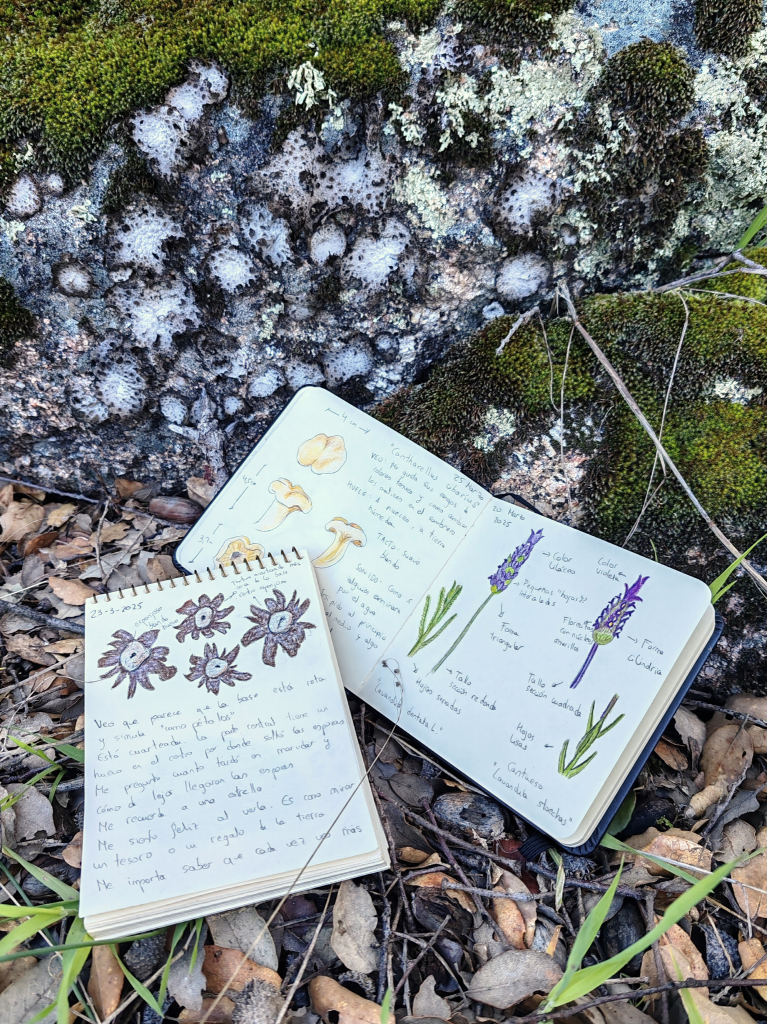
Benefits
- Develop the Mindfulness and the sense of presence calming your nervous system (allowing us to live at a slower, more relaxed pace)
- Enables the cognitive improvement, facilitates the learning and the development of the intelligence as it pushes you beyond what you already know, it enables you to make connections and develop useful skills such as writing, drawing, taking notes, etc., which enhance your brain’s capabilities.
- Promotes neuroplasticity. The new neurons generated in adulthood are lost if we do not use them. Keeping a nature journal «nourishes» your brain and allows us to reconfigure and shape it in a healthier way
- Sketching, taking a broad view and being mindful of your surroundings helps to develop the right side of your brain, which is responsible for a holistic, spatial and perceptual perspective; lateral and global thinking, etc. It enables greater cross-connections via the corpus callosum, allowing for a a more inclusive and collective approach.
- Myra A. Fernandes et al. (2018) highlight the importance of creating diagrams and drawings as excellent tools for improves memory by promoting the integration of written, pictorial and motor codes, which facilitates the creation of a contextually rich representation. In other words, annotations and sketches allow you to highlight what is important to you, develop your understanding and establish more durable memory banks.
- We all have automatic patterns that lead us to make the same mistakes, and of which we are often «unaware». When we keep a Nature Journal, we allow ourselves to reflect on our connection with what we observe; we strengthen our awareness and attention; and we can uncover our patterns so that we are aware of them when they recur. In other words, we encourage the Self-awareness and the Mental Reprogramming with new codes and ways of thinking
- Our brains are wired to store negative experiences. It is very important to incorporate pleasant experiences, feel grateful for them and anchor them in our memory. Keeping a Nature Journal allows you to create new, pleasant memories to make life easier and more beautiful; in other words, it allows you to «Anchoring positive experiences«
- We promote the emotional processing whether to calm momentary emotions or to reflect and consider how we feel whilst we are out in the natural world. Thus, this tool not only enables us to observe the outside world closely, but also allows us to discover ourselves, how we feel, and how what we are observing affects us.
- Stimulates Curiosity enabling us to discover our surroundings, to look beyond the familiar with a deeper and more detailed perspective, and to find a sense of «wonder» and «beauty» in the process
- It brings out our artistic side. As there are no set rules and it encourages the use of the right brain, the Nature Journal is a fantastic way to express our artistic side through drawings, sketches, poems and so on.
- It stimulates the imagination and broadens our ability to see beyond. It helps us to broaden our perspective by asking ourselves questions with several possible answers and outcomes. In this way, we train our minds to be «multifactorial» and «multi-perspective», which is very useful for solving everyday problems.
- Strengthens the environmental link and what we call the «Human-Nature Relationship». Becoming more aware of the species that inhabit our surroundings, learning more about them, their lives and circumstances, fosters empathy towards the environment.
- It improves our social connections. If you keep a journal as part of a group – such as in a workshop or when meeting up with friends – you’ll enjoy the experience of sharing your thoughts and learning from one another. But even if you do it on your own, you’ll be able to improve your relationships by delving deeper into your feelings and taking the time to reflect on your experiences, patterns and how to change them. Nature teaches us far more than we realise.
- Last but not least, we cannot overlook the great benefits of keeping a Nature Diary outdoors, which means, in addition to the above, allows you to enjoy all the benefits of the natural environment, such as better air quality, breathing in the volatile compounds released by plants and trees, listening to natural sounds, and receiving colour therapy (blue and green), etc. In short, all the the benefits that the natural environment offers us.
We experience the world according to our state of mind. We can train our minds and choose wisely what to focus on. Haenim Sunim
You need
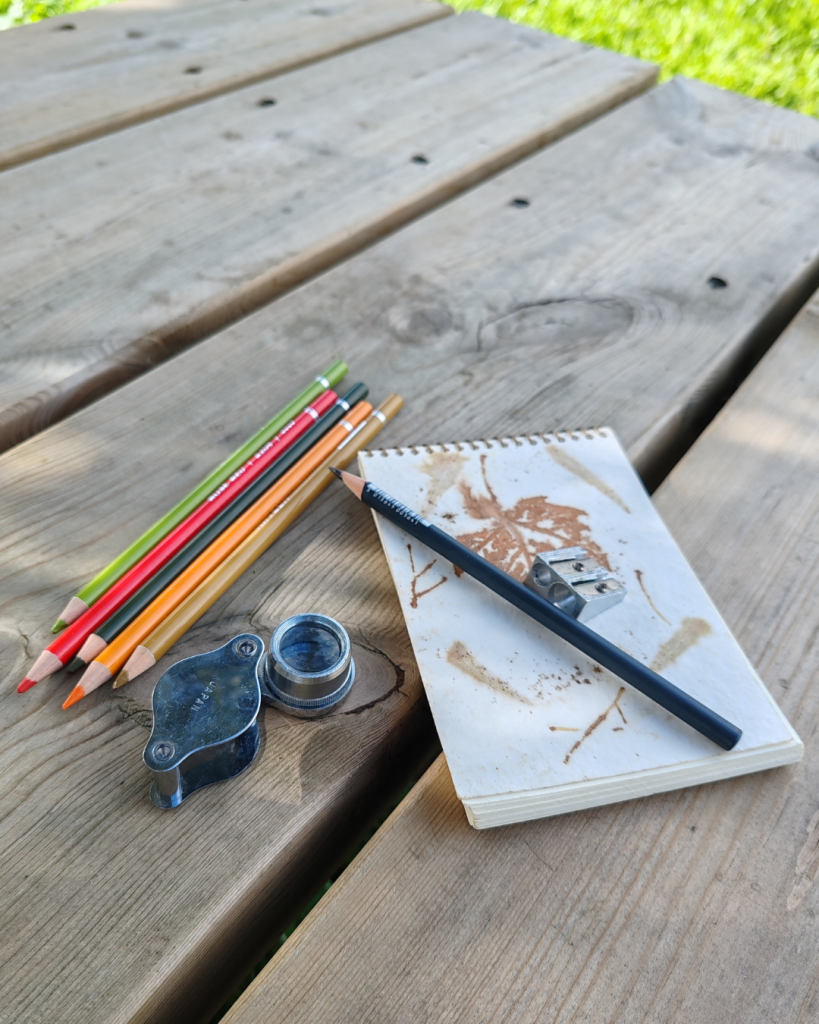
- One notebook. It should be big enough to capture what you want, but small enough to carry with you wherever you want to practise. It can have blank pages, but some people prefer lined or squared paper.
- A pencil, mechanical pencil o boli.
- Rucksack o stock market to transport the materials
- If you like colouring in pictures, you can take them with you coloured pencils, watercolours, crayons, pastels or graphite pencils.
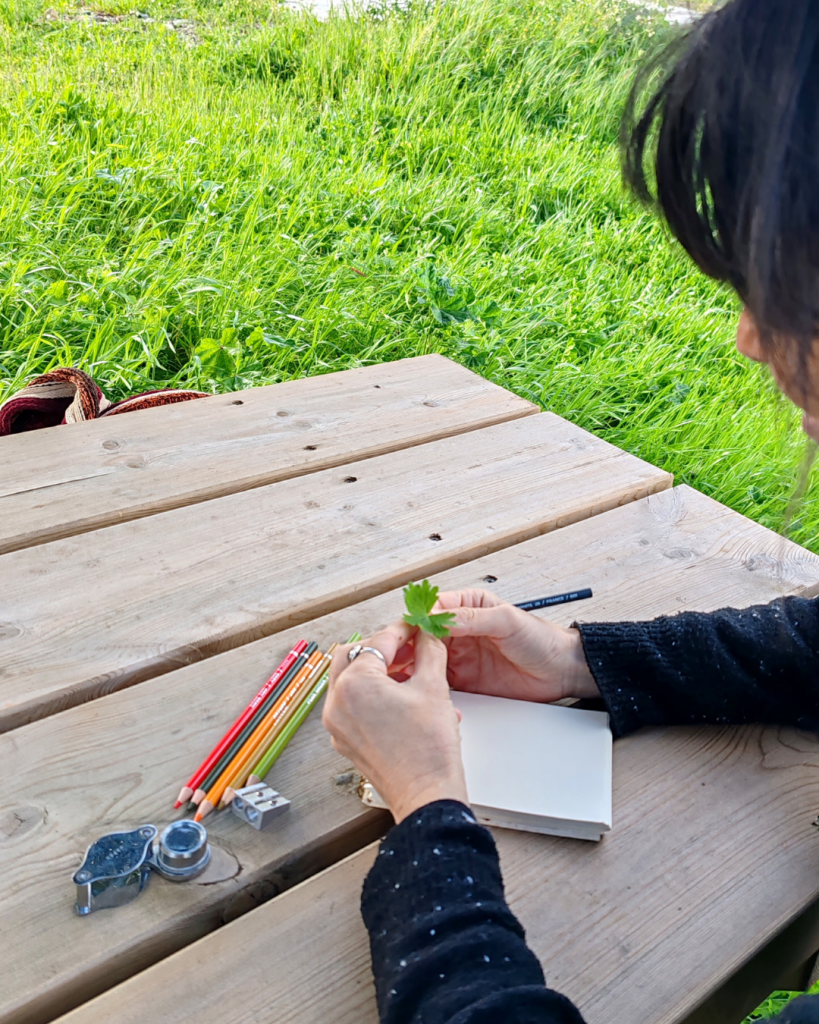
- If you like looking at small things, a magnifying glass
- If you like to record the size of what you see, you’ll need a rule o measuring tape
- Adhesive tape if you’re going to stick on a leaf or a feather….
- If you’re the sort of person who enjoys watching birds or animals from a distance, you’ll need some binoculars
- In short, anything you can think of that you reckon will be useful.
Useful tips
- Choose practical materials that you LOVE. You should like your notebook, pencil and so on; you should feel like picking them up and find them comfortable to use. A nature journal is very personal – it’s all about you – so you don’t have to follow any set rules.
- Choose a SPOT. Depending on your circumstances, you can choose a spot surrounded by nature, your garden or a park. Any place where you can interact with some aspect of nature can be helpful. Even in the city, you can look for a spot near a tree or a green space.
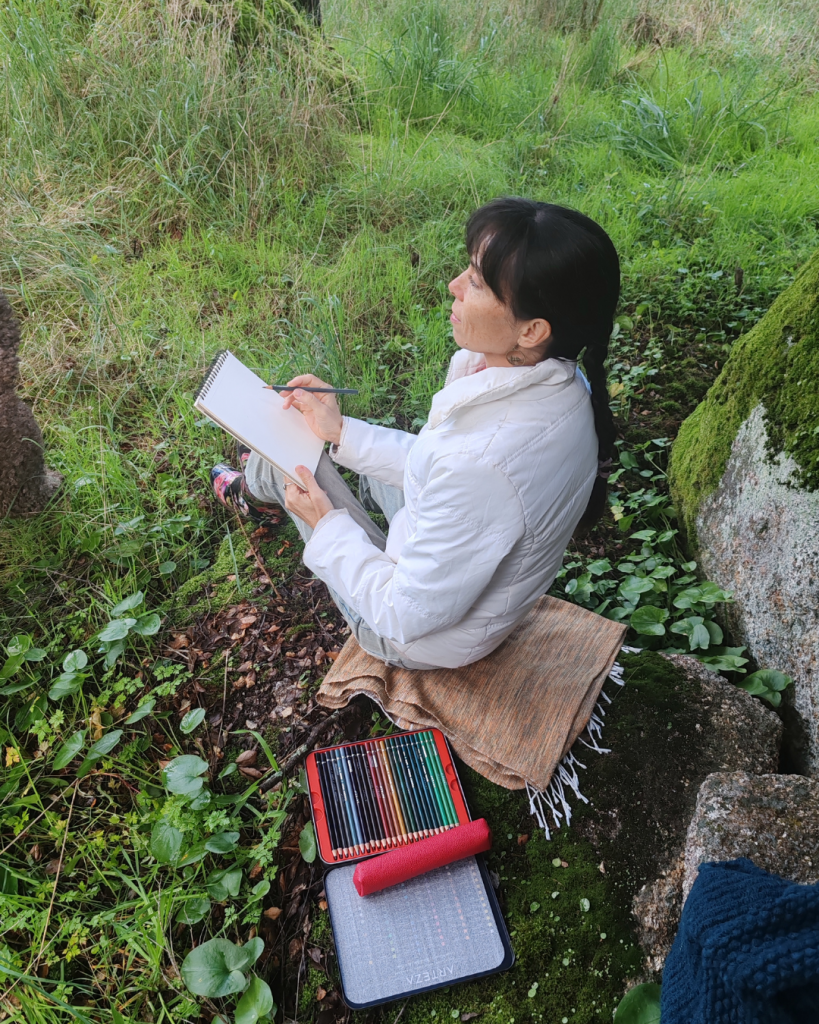
- Make a note DATE AND TIME. It is good practice to note down the time at which we carry out this Natural Connection exercise, particularly if we are going to do «cyclical» exercises in which our observation focuses on the passing of time and the changing of the seasons.
- FIRST IMPRESSIONS. If you’re finding it hard to decide where to focus your attention, you could start by making simple, general notes about the weather – what the sky is like, the temperature, the direction of the wind, the phase of the moon, whether you can see other people or not, and so on.
- THE «AWE» EFFECT». Explore and observe until something catches your eye. That feeling of «Wow» or «awe» that makes us feel beauty, enthusiasm, presence, and so on…
- Have a go with one OPEN-MINDEDNESS. Put aside your critical side, your perfectionism, your high standards and your self-criticism. The important thing is to enjoy the experience.
- Join us QUESTIONS and ENQUIRIES GENERIC. I see that… / I wonder… / It reminds me of… / I feel… / I care about… or SPECIFIC What sort of tree is it? What sort of butterfly will this caterpillar turn into? If you’re doing this activity with children, you could include QUESTIONS SUCH AS: What can you see? What questions do you have? Does it make you think of anything in particular? How does it make you feel (nervous, angry, curious, connected, sad…)? What do you like most about this? Or questions such as ‘What?’, ‘Who?’, ‘How?’, ‘Where?’ and ‘Why?’
- LEAVE THE PLACE UNTOUCHED. A nature lover observes. They do not damage the place. Keeping a nature journal is based on the principles of conservation, documentation and empathy towards the environment. Take your food waste with you to dispose of it in a bin. Do not collect more than you need, so as not to cause a significant impact. For example, only take plants that are in abundance and never uproot them; take only what you need and show gratitude for what you find.
Some approaches
- NOTES. Make a note of what you see to practise mindfulness and observing the details we normally overlook. It’s a good idea to draw a «sketch» or «rough drawing» and make notes of what caught your attention most, or to include reflections on what you perceive through your senses
- CREATIVE WRITING. For example, write an essay about what you observed, make up a story or tale about what happened there, or write a poem or haiku inspired by your observations. At the end of your piece, it’s a good idea to make a note of the objects or experiences that inspired you.
- REFLECTION: «THE PASSING OF TIME». We can draw pictures or write down what we think that place was like months or years ago. We can ask ourselves questions about people: What was here before? What did people do here? How did they live? What other plants or animals were there? What problems did they have to deal with?; or questions about natural processes: How did this stone get here? How did the seed of this plant get here? Has this animal always been in this area?
- DRAWING. Taking your time to create a good drawing is another way of capturing your feelings in a notebook. In this case, the focus is not so much on taking notes and jotting down ideas, but on capturing the «soul» of what you’ve observed through a drawing. You can draw anything from landscapes to small objects, create detailed drawings or just sketches, explore the three dimensions of an object by drawing it from three different perspectives, include diagrams, comics, etc.
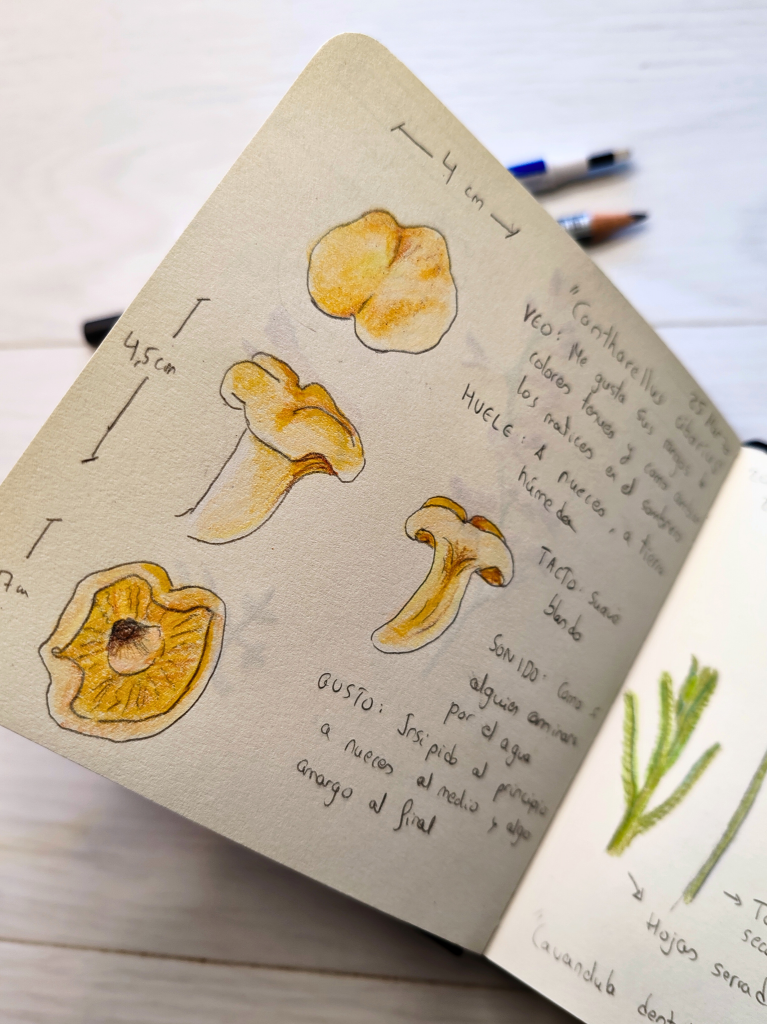
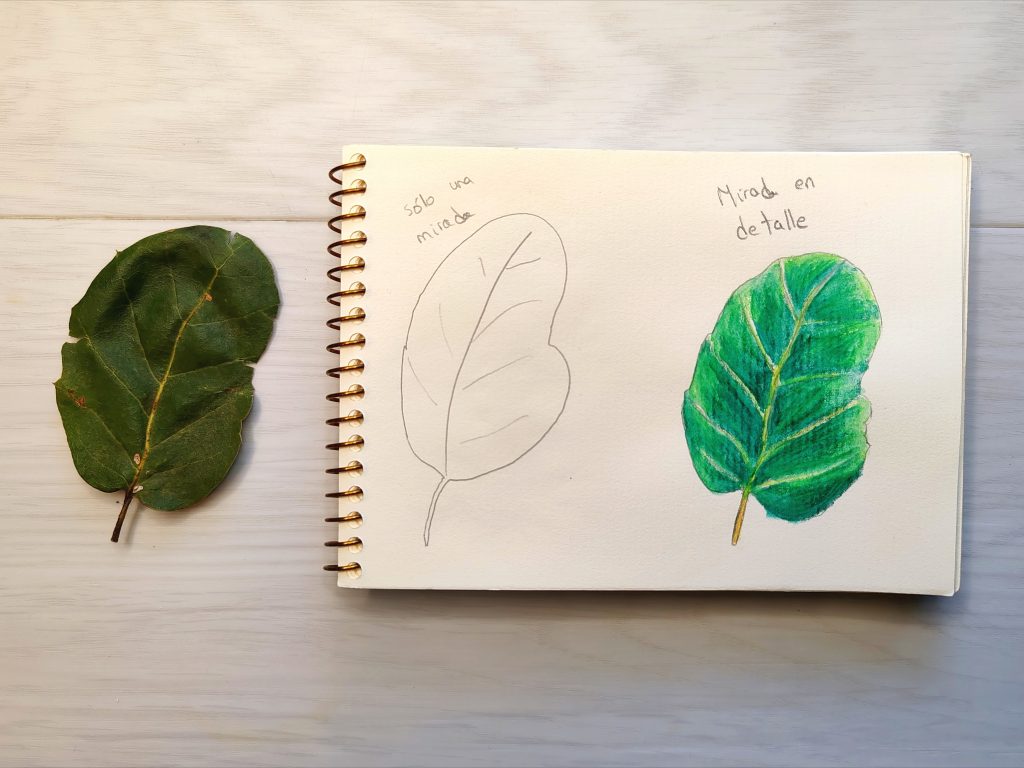
- LEAVES and FLOWERS (HERBARIUM). One thing you could try is putting leaves and flowers in your diary to let them dry.
- MAP. Draw small maps highlighting important features that help you orientate yourself in space.
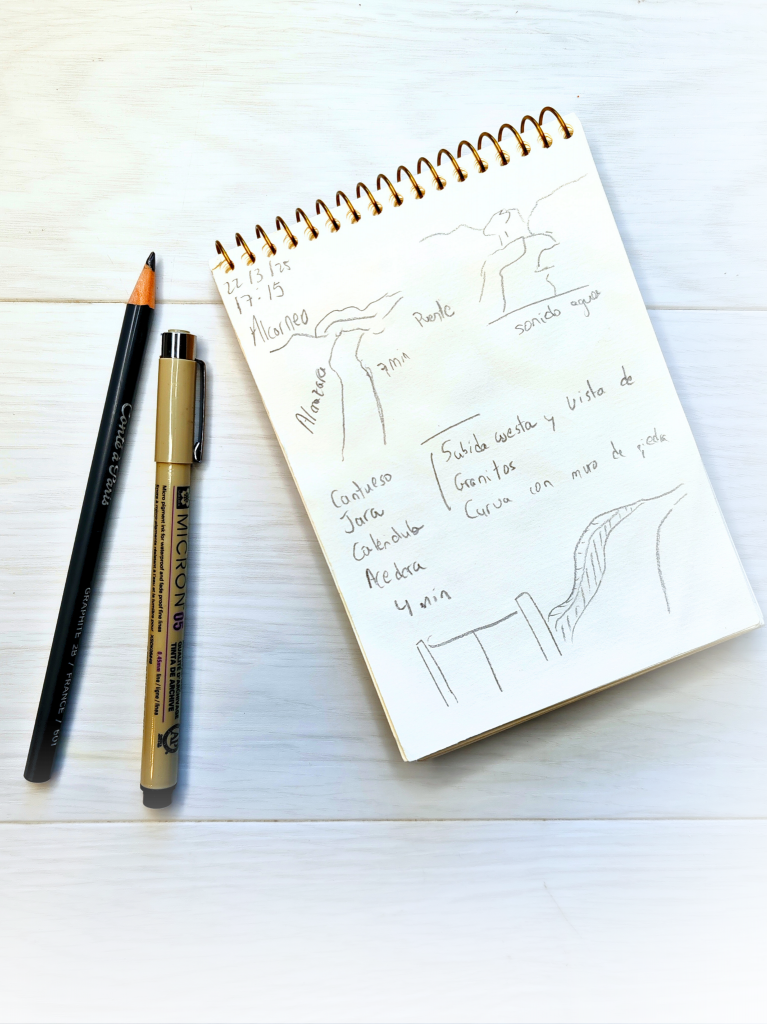
- Sonic Landscape. Draw a map of the area with yourself in the centre and mark the sounds you hear on it. You can use symbols, diagrams, lines and sketches. You don’t need to know everything. If, for example, you hear a bird but don’t know which one it is, you can draw a generic bird symbol and write down the sound of its song next to it.
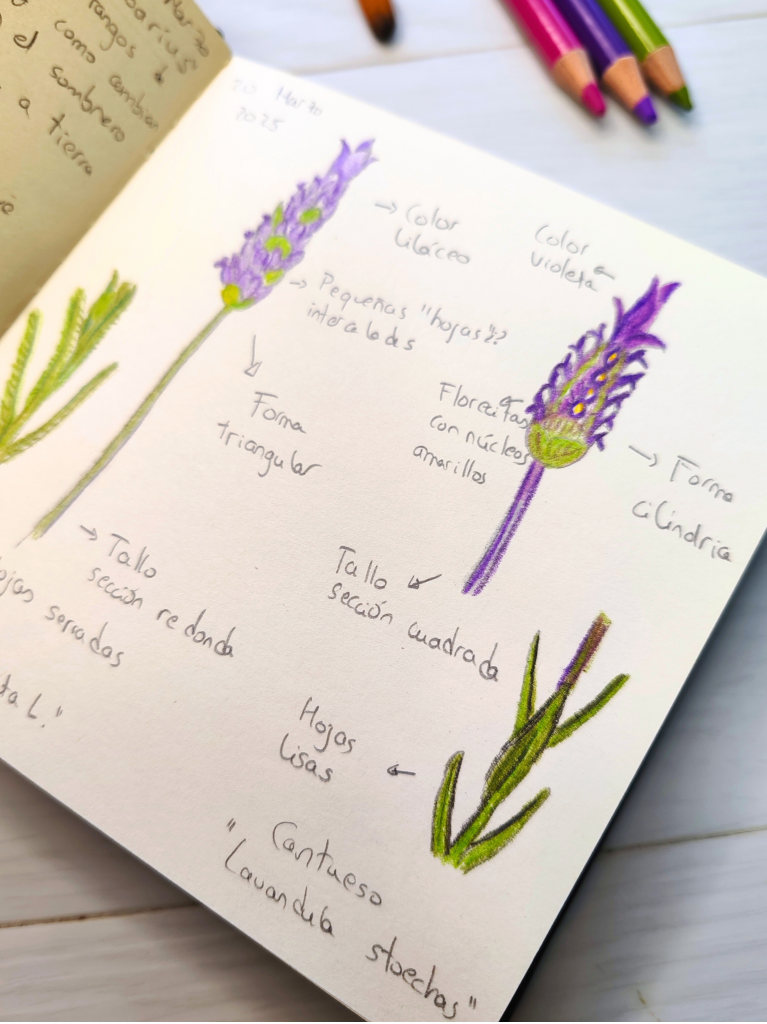
- NUMEROLOGY. Observe, paying attention to proportions and numerical data. You could draw a flower with five petals, take measurements with a ruler, note down the time elapsed between one verse and the next, etc.
- SCALE. Draw an object using three different scales and zoom levels. Draw the object in its context, then show the whole object in closer detail, and finally draw a close-up of an area that catches your eye.
- COMPARATIVE TABLES. Take two similar objects. Draw a picture of each of them in a comparison table and note down the similarities and differences between them
Some Old Nature Journals
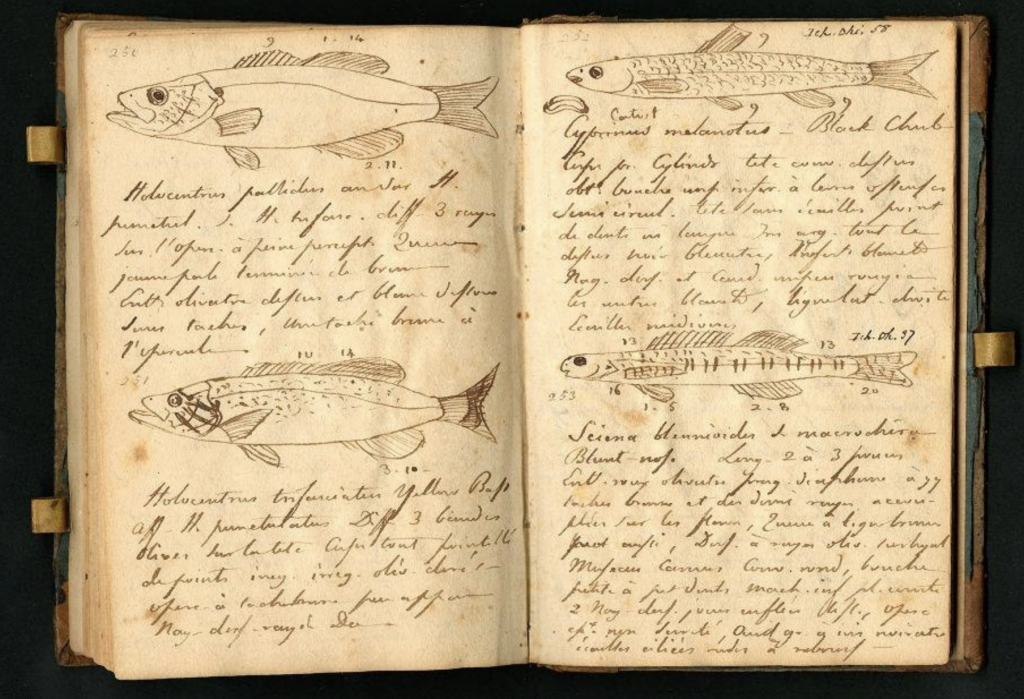
Constantine Samuel Rafinesque, c. 1820s in the Americas (www.exploringoverland.com)
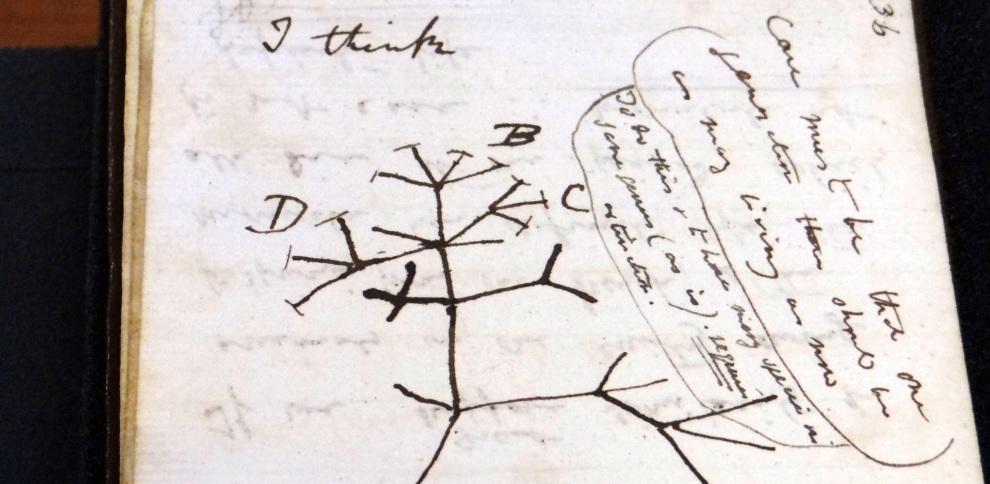
Drawing by Charles Darwin from 1837 illustrating the evolution of species. ‘Tree of Life’, Stuart Roberts/AFP
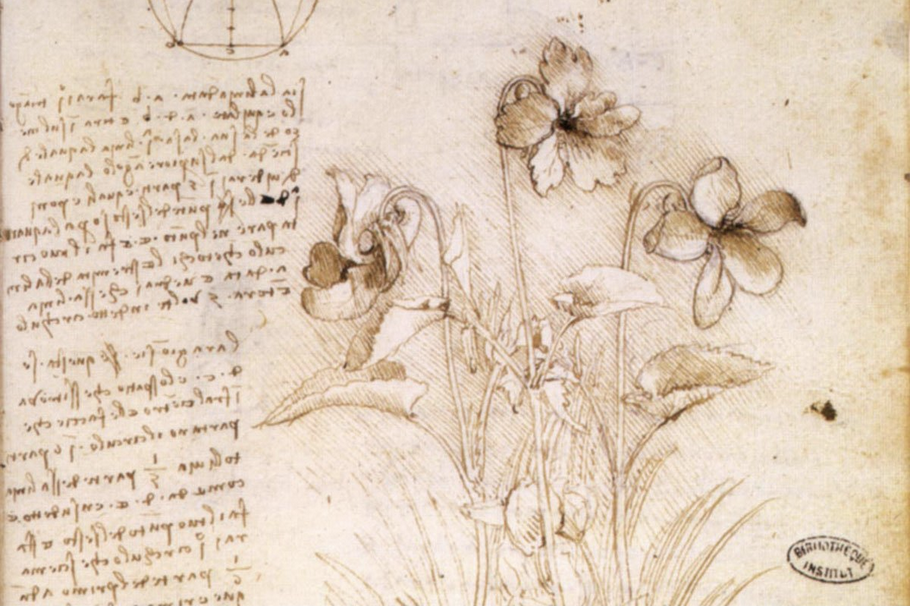
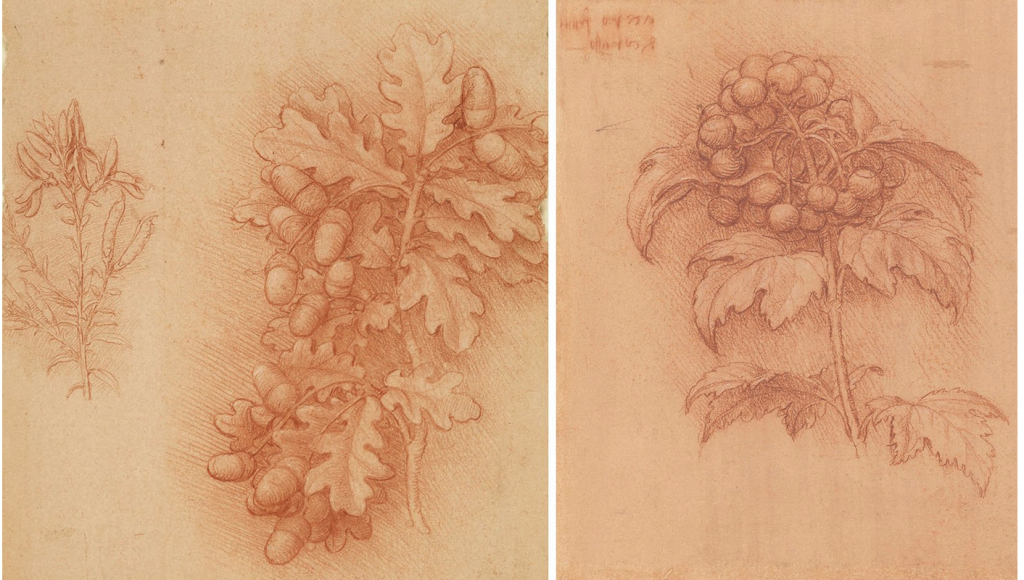

Drawings by Leonardo da Vinci, 16th century (www.nesbaartists.com)
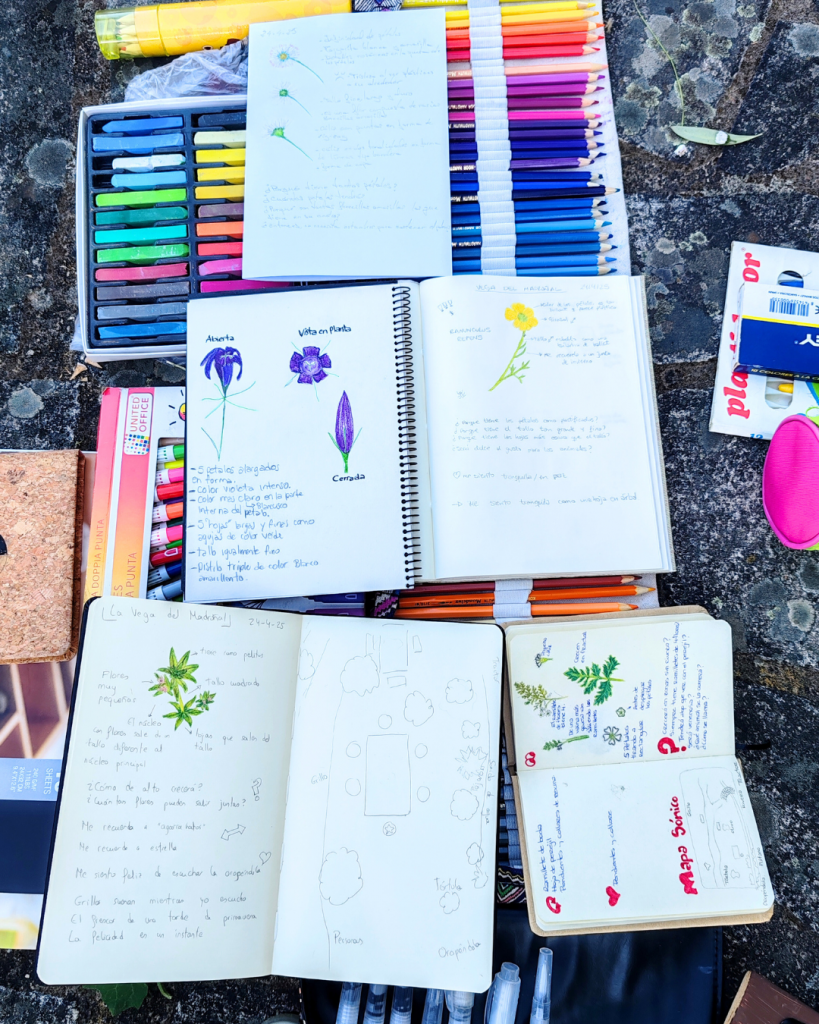
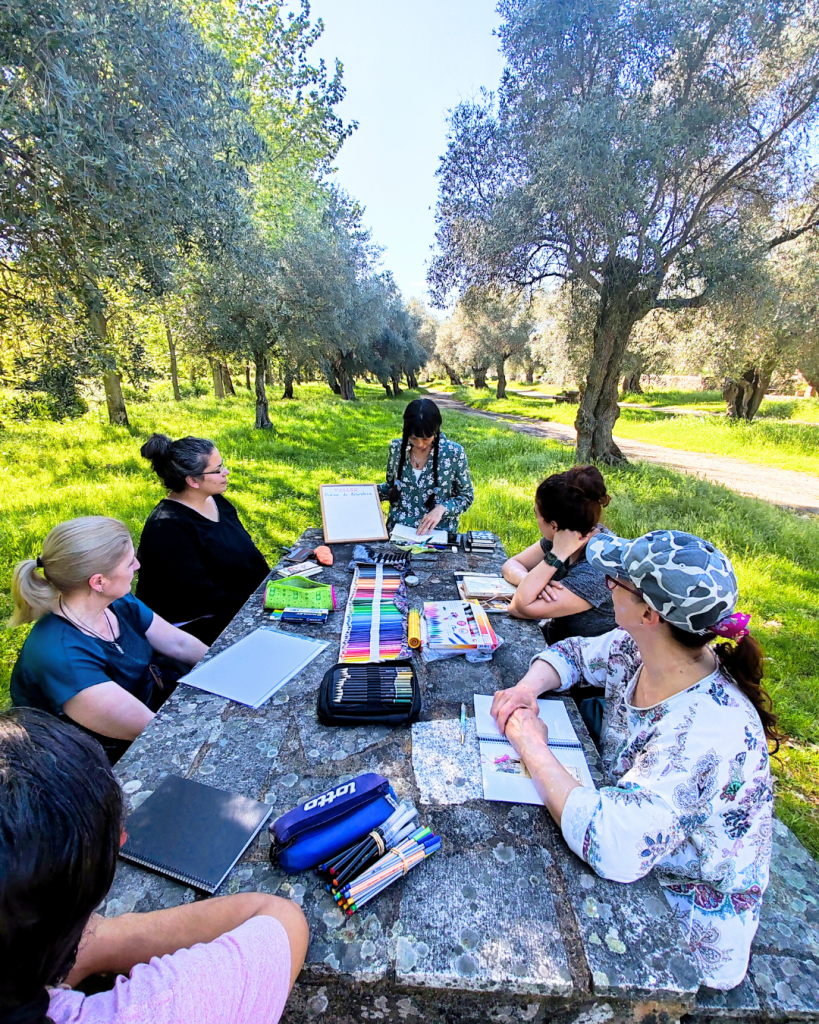
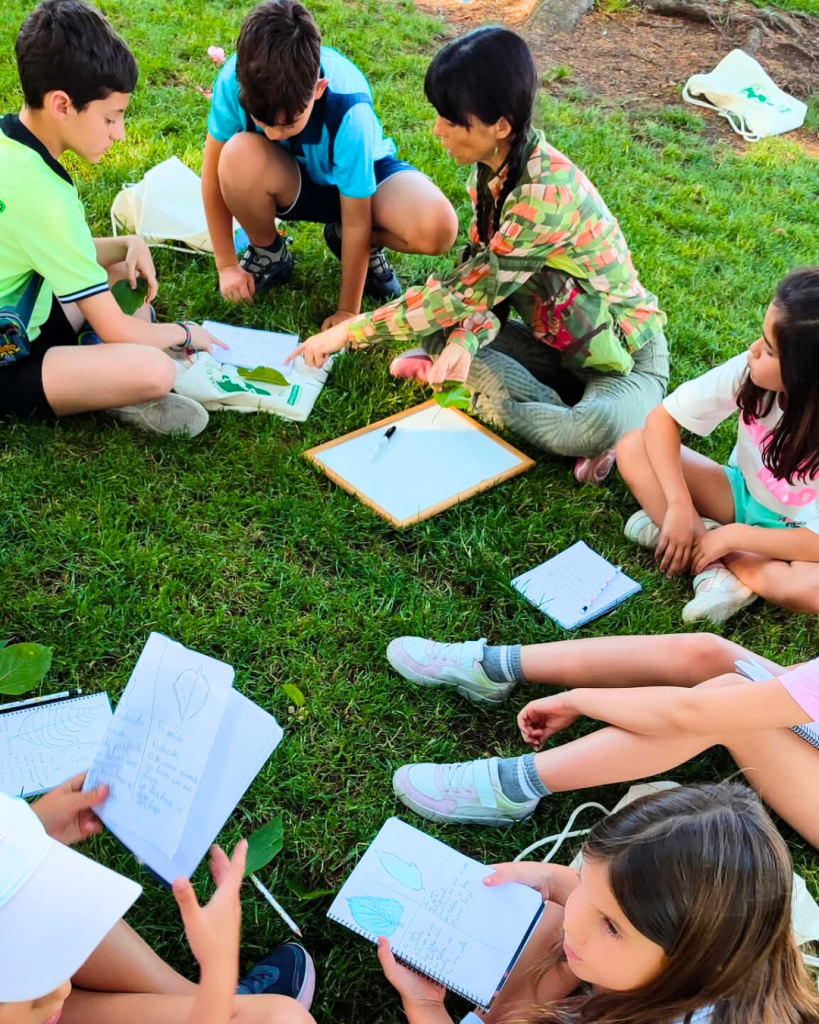
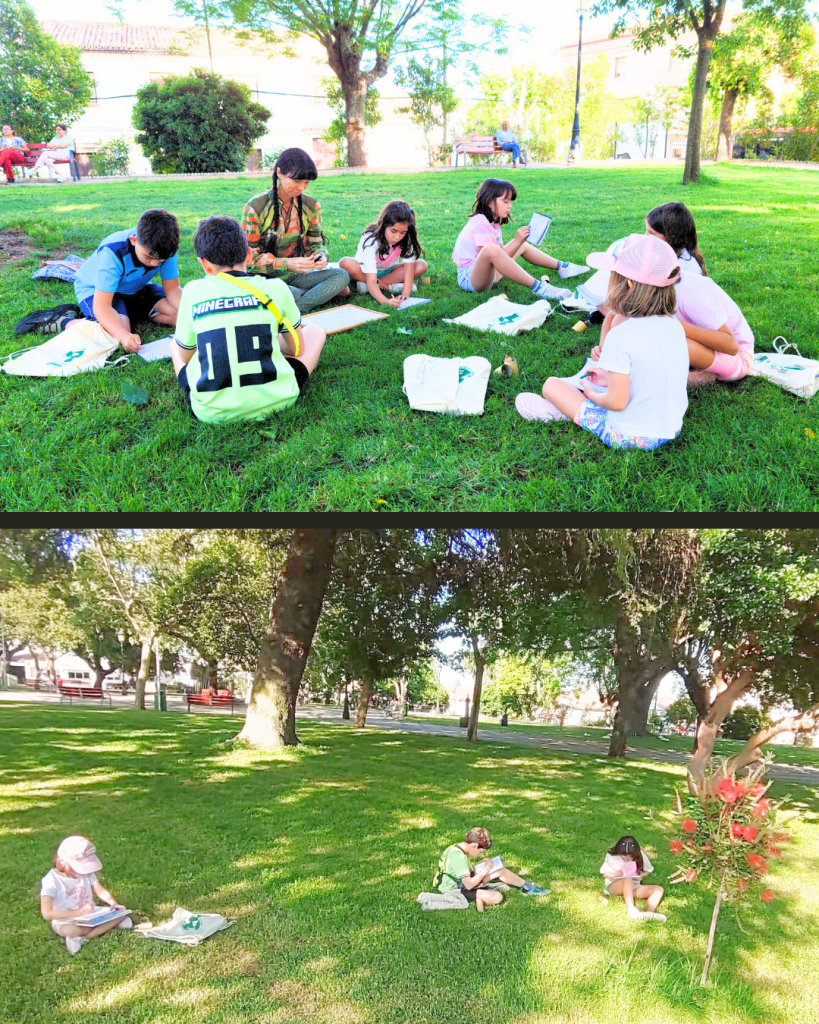
SOME PHOTOS
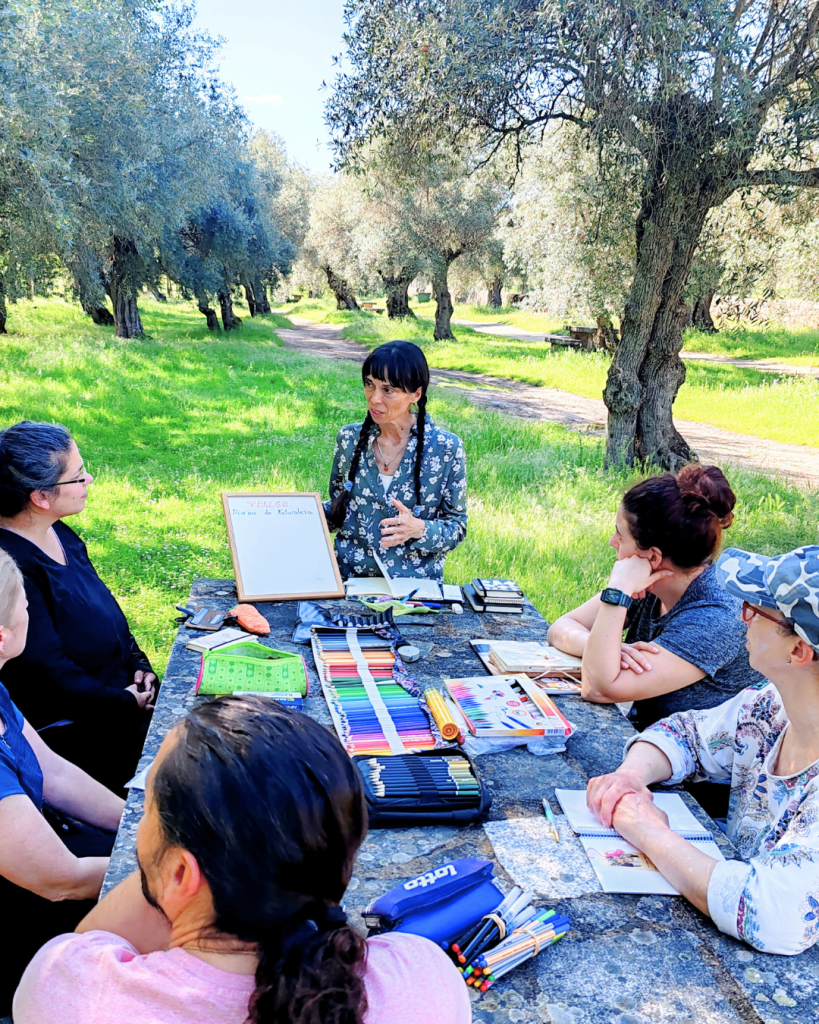
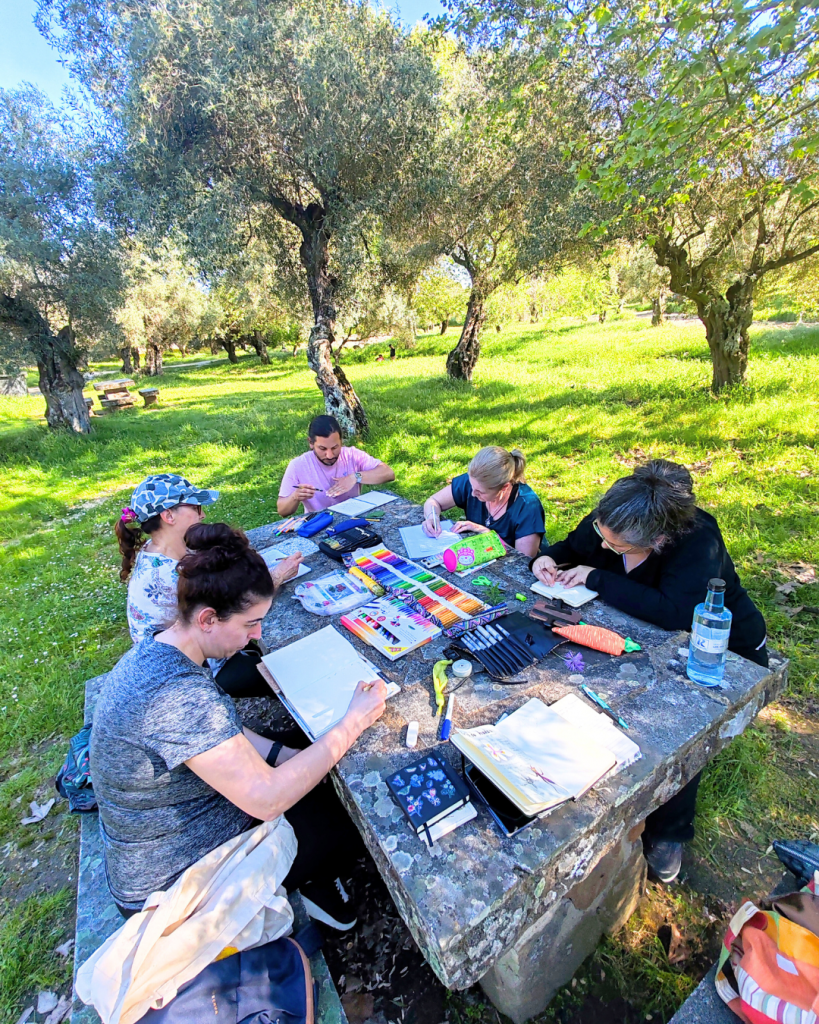
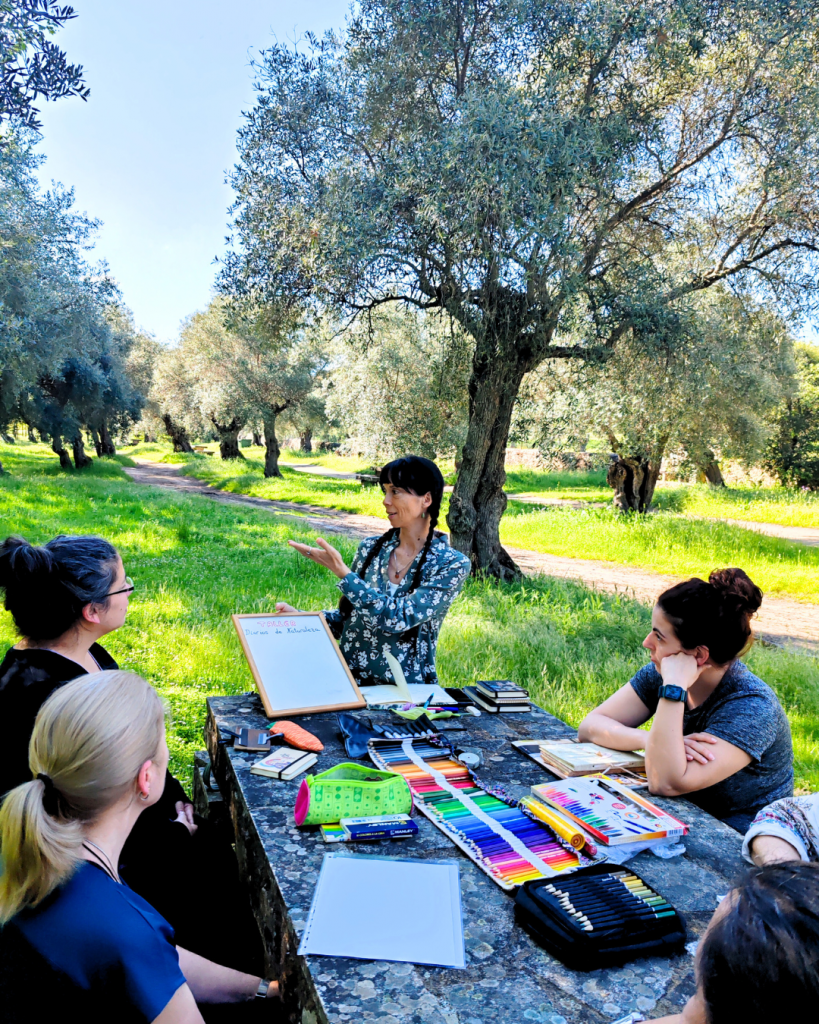
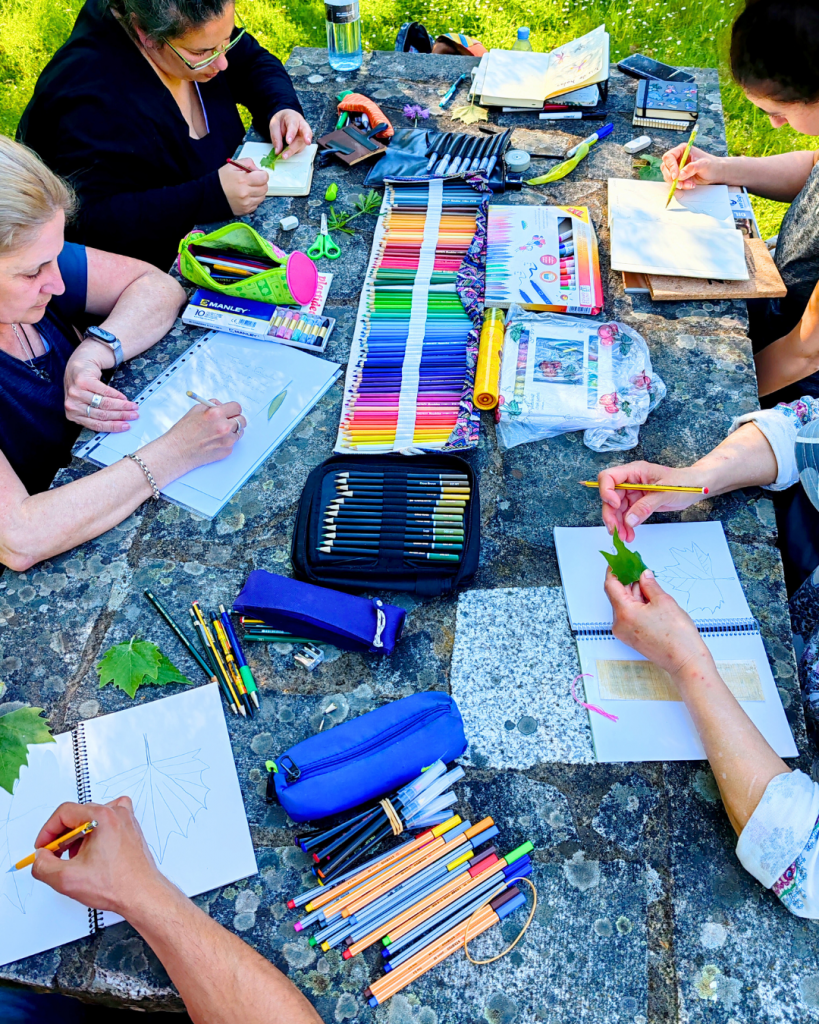
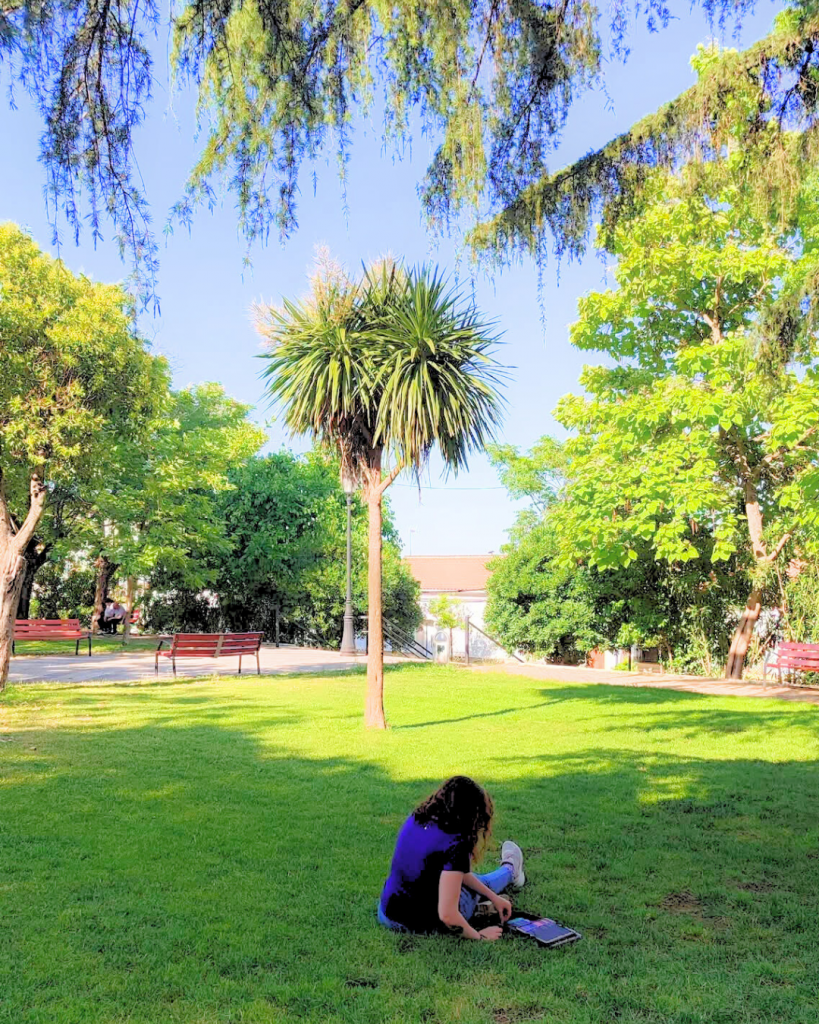
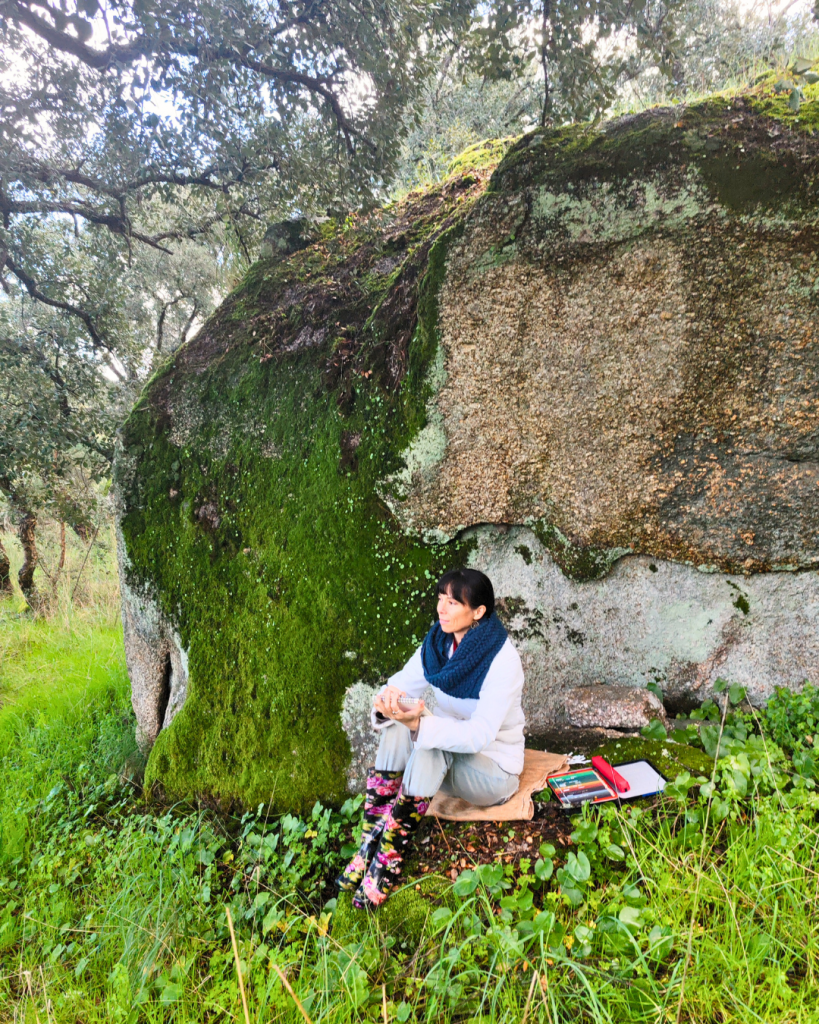
Nature Journaling Workshop for adults
In the Vega del Madroñal (San Vicente de Alcántara, Badajoz)



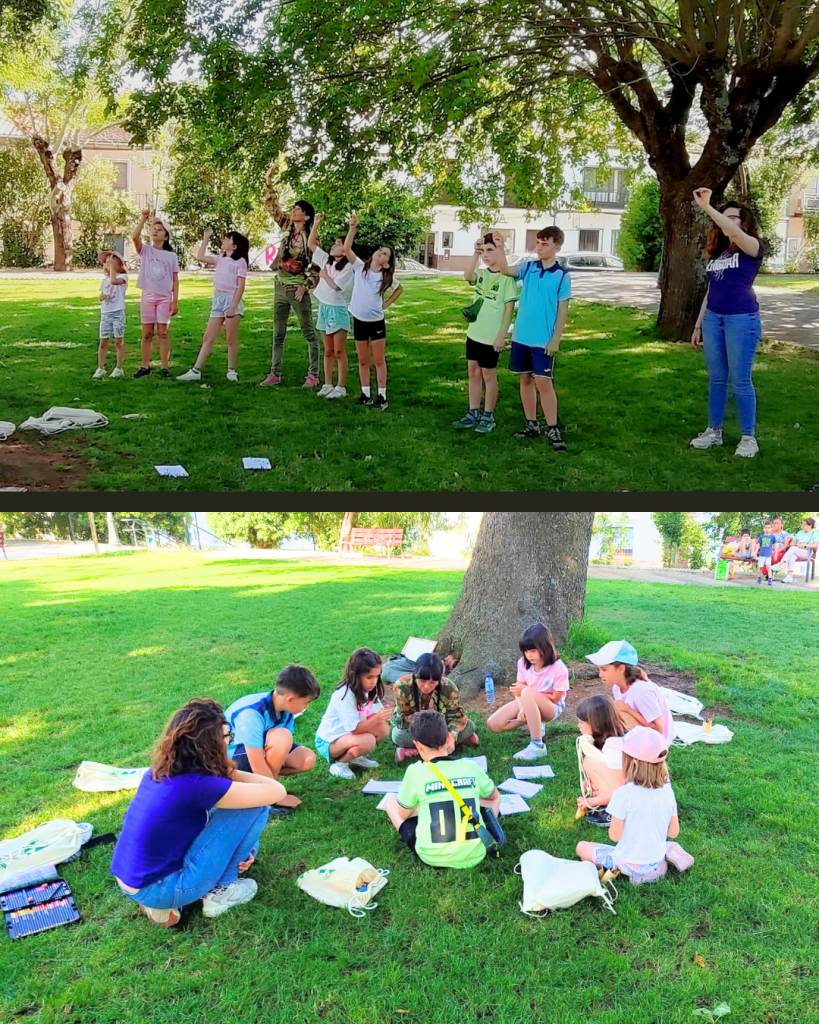
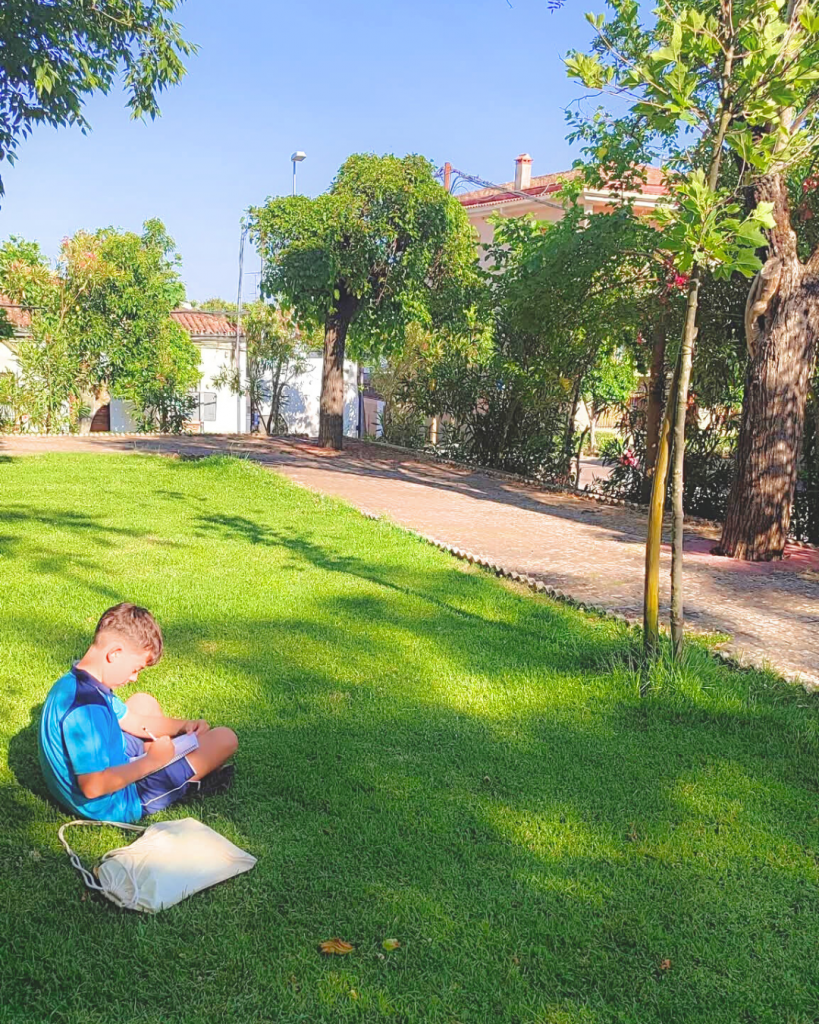
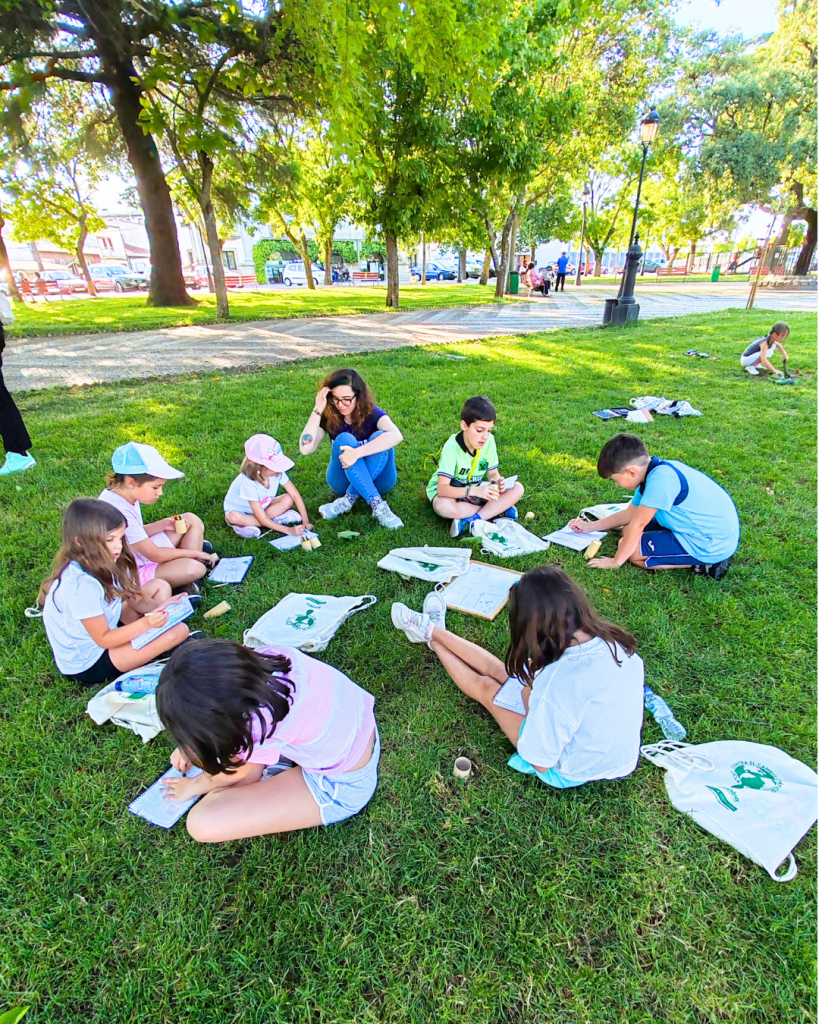
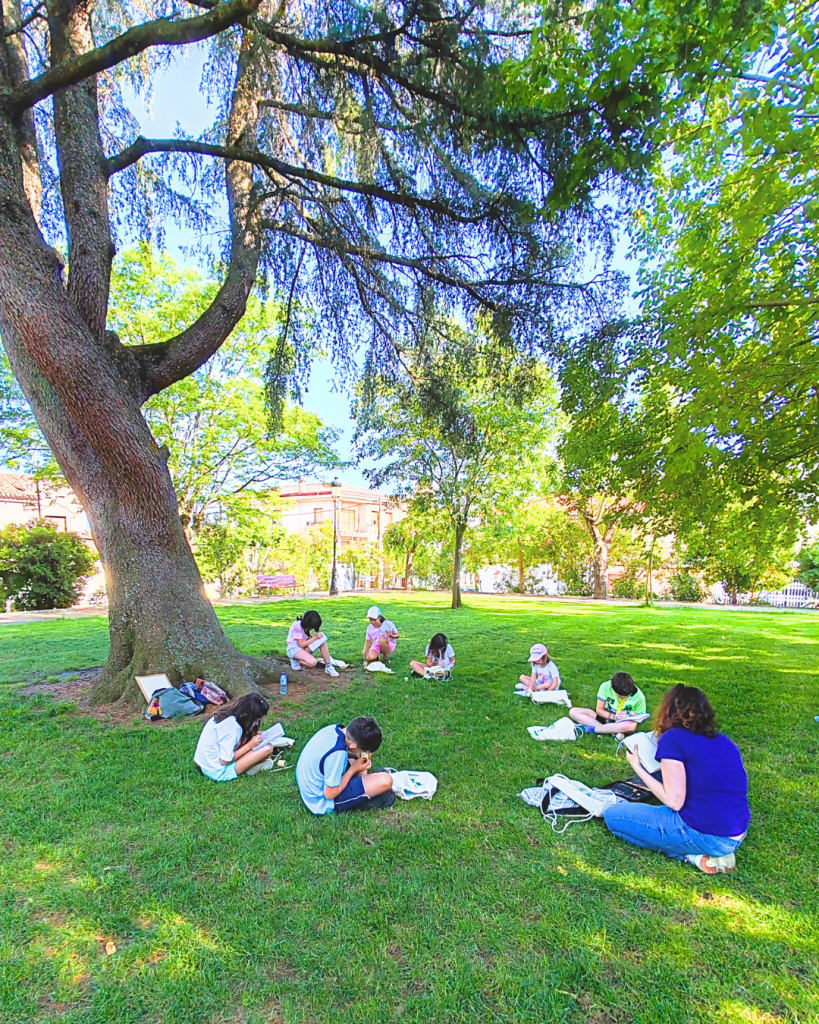
Nature Journal Workshop for Children
In Parque de España (San Vicente de Alcántara, Badajoz)



Would you like to join in our activities?
If you’re interested in the Nature Diary and would like to take part in a group session, or if you’re interested in any of our nature activities, please email us at info@umanagea.com to find out about upcoming events, or follow us on social media.
© This text has been written and illustrated by Helena Chacón, PhD. All rights reserved.

I absolutely loved the idea. Thank you.
Thank you, Margot. We’re glad you liked it. 🙂
How interesting – a different form of meditation and mindful observation, which I think makes it easier to remember and feel the unity between us all and with nature itself :).
That’s really interesting, Olga. It helps us to pay attention to the details, to remember things and to develop our awareness.